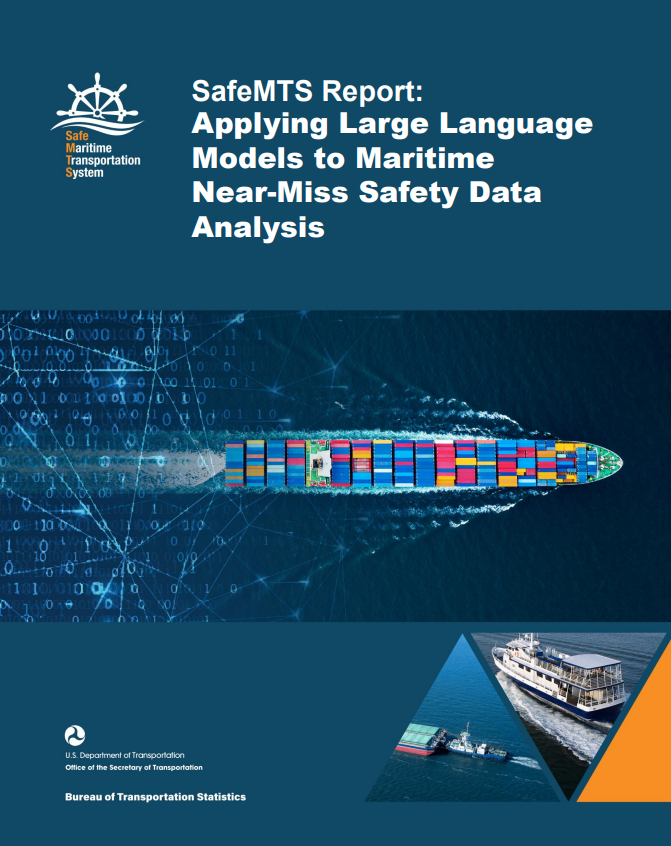
The Safe Maritime Transportation System (SafeMTS) program has released a special report detailing the results of a pilot project testing the use of large language models (LLMs)
to process and analyze near-miss safety event data in the commercial maritime industry. Near-miss events - incidents in which a potential accident, injury, or hazard was narrowly
avoided - are critical for identifying early warnings and preventing serious maritime incidents.
Featuring a review of anonymized participant-submitted near-miss data, the report evaluates how automated text classification, taxonomy mapping, and human-in-the-loop review can reduce
time-consuming manual analysis, improve data comparability, and support more rapid identification of safety risks and operational trends across diverse datasets.
The SafeMTS team’s research included a review of existing program taxonomies and data definitions, pilot testing of secure LLM workflows, and validation by subject matter experts from
both maritime operations and data science fields. In addition to findings related to classification accuracy, efficiency gains, and emerging trend detection, the report identifies current
barriers to full-scale implementation, such as inconsistent data formats, incomplete records, and varying reporting cadences, and also outlines recommendations for addressing these challenges
before expanding the use of LLMs within the program.
The report aims to inform maritime companies, safety managers, researchers, and regulators about the potential of advanced language-based analytics to strengthen maritime safety programs.
For example, the SafeMTS team has already shared detailed safety trends that have emerged from the study as part of one-on-one meetings with commercial maritime companies currently participating
in the program. By enabling faster and more consistent analysis, SafeMTS seeks to support enhanced safety management practices, more actionable industry-wide insights, and stronger prevention strategies.
Download the LLM Pilot Report from the SafeMTS website’s Publications section.
About SafeMTS
SafeMTS (https://www.c3rs.bts.gov/safemts-home/) is sponsored by the U.S. Department of Transportation’s Maritime Administration (MARAD)
and administered by the Bureau of Transportation Statistics (BTS), in partnership with the commercial maritime industry. SafeMTS provides a voluntary, confidential reporting system for near-miss safety events,
enabling companies to share sensitive and proprietary data without risk of exposure.
As a principal federal statistical agency, BTS has the authority and obligation under the Confidential Information Protection and Statistical Efficiency Act (CIPSEA) and the agency’s
authorizing statute to protect the confidentiality of submitted data, including company information, personally identifiable information, and proprietary details. Submitted identifiable
data are protected from release to the public, MARAD, and other government agencies, and are exempt from Freedom of Information Act requests.
To learn more about CIPSEA and data protection at BTS, visit: https://www.bts.gov/confidentiality.
Learn more: