
Publications
Not finding an answer to your SafeMTS question? Read the FAQs to see common questions we receive from interested stakeholders by expanding the below text boxes.
A partnership among the U.S. Department of Transportation’s Maritime Administration and Bureau of Transportation Statistics, and industry, SafeMTS helps all participants identify early warnings of safety problems and develop strategies to avoid more serious incidents. It is a voluntary near-miss incident data collection program for the maritime industry aimed at increasing industry safety through trend analysis and benchmarking.
Most companies operating U.S. flagged vessels have some sort of internal safety data reporting program; however, due to legal and commercial concerns, these data are not being shared widely among stakeholders. SafeMTS was established to close this gap in safety data and information sharing across industry by offering operators a confidential method to share important safety data.
As a participant, you are able to securely share incident related data and, in return, see aggregated industry data for various segments of the maritime industry. This can be useful for identifying potential areas of improvement in your own safety system. Their anonymous data will also allow the rest of the industry to get a full picture of the types and frequencies of incidents being seen across fleets.
All participant data is aggregated in such a way that the information is anonymous (devoid of any details that will permit attribution of the data to a particular vessel or company). As an independent federal statistical agency, BTS has the authority and obligation under CIPSEA and the agency's authorizing statute to protect the confidentiality of your data, including but not limited to company information, personally identifiable information, and sensitive or proprietary information. By submitting to BTS, your data are protected from release to the public and other non-CIPSEA federal agencies. Data are also protected from subpoenas and Freedom of Information Act requests.
In 2002, Congress passed the Confidential Information Protection and Statistical Efficiency Act (CIPSEA) which stipulates that an agency may collect information under pledge of confidentiality for statistical purposes. CIPSEA protections include:
Data requiring confidentiality protection include sensitivity, proprietary, or private data; examples include:
Non-confidential information includes preventative safety actions recommended for implementation by subject matter experts or stakeholders, and any documents developed for public dissemination using confidential data (e.g., annual reports of aggregated data to stakeholders).
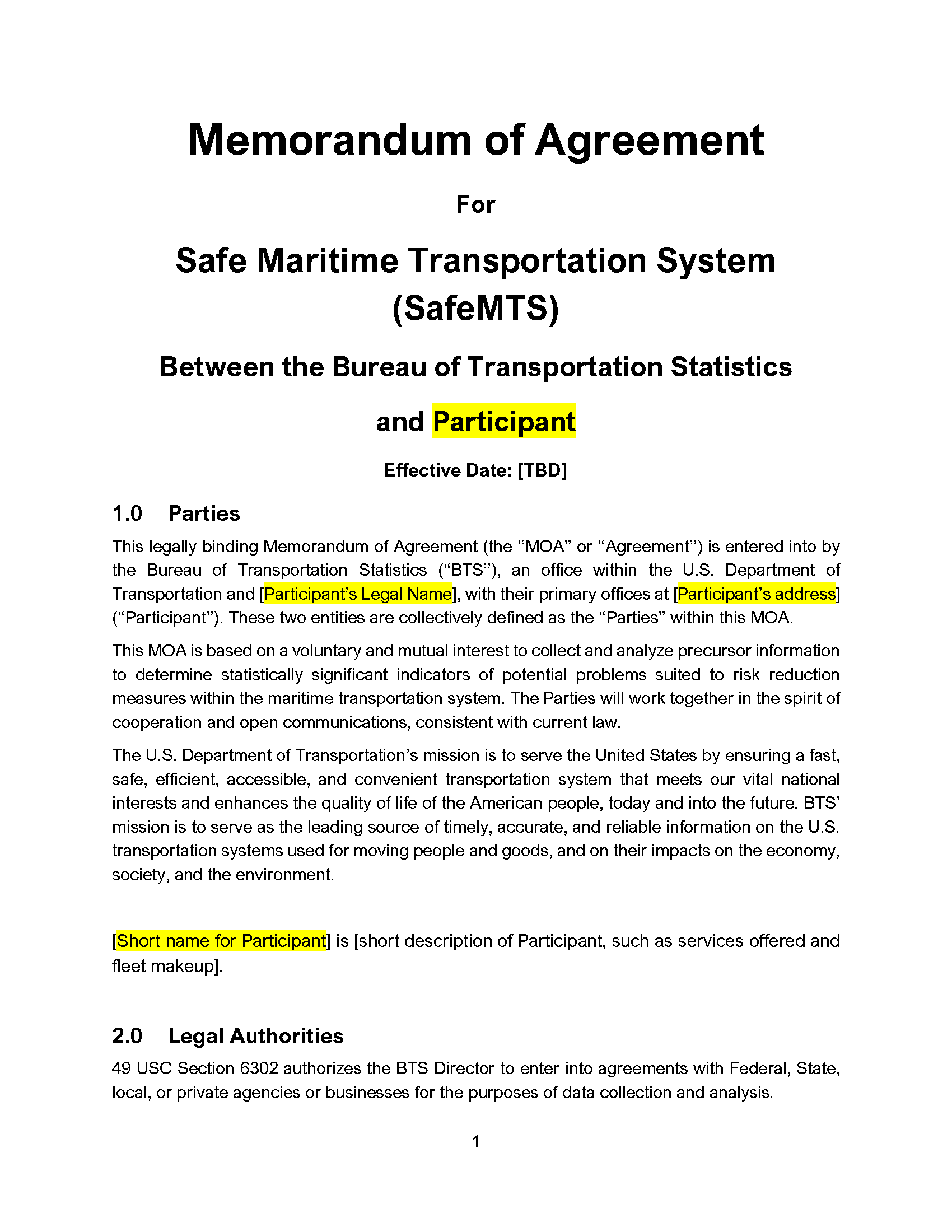
Any U.S. Flagged Vessel Owner/Operator who is actively engaged in or is interested in starting the collection of near-miss incident data for the purpose of improving vessel safety can participate. Once a company decides to voluntarily submit its safety data to BTS, the first step is for that company to meet with BTS to discuss the elements of a Memorandum of Agreement (MOA). A sample MOA can be found here, in Appendix C. The MOA is specific to each company and details the scope of the engagement between the company and BTS, including the following:
Once your company has entered in the MOA with BTS, you can begin submitting data through BTS’s secure data portal, the steps which can be found in this user guide.
BTS recommends that participants submit data on a quarterly basis, at minimum, to allow for timely sharing of information and results. More frequent submissions may be coordinated with an individual participant as outlined in their Memorandum of Agreement with BTS.
The Bureau of Transportation Statistics (BTS) was established in 1992 as an independent Federal statistical agency within the U.S. Department of Transportation with the mission to serve the public and other Federal agencies. As a Federal statistical agency, BTS’ primary function is the compilation and analysis of relevant and accurate data and the dissemination of information for statistical purposes, thereby allowing the users to make informed decisions Principles for all Federal statistical agencies include relevance to policy issues, credibility among data users, trust among data providers, and independence from political or other undue external influence, because BTS: